

The Bible describes heaven as God's dwelling and promises his people life with him. Its final vision brings that hope close: a city comes down, and God makes his home with people.
On this page
Jesus promises a place with him
In John 14, Jesus speaks to disciples facing his departure. He tells them about his Father's house and says he is going to prepare a place for them. The promise reaches its heart in verse 3: he will receive them to himself so they can be where he is.
The King James translation calls the places in that house 'mansions'; many modern translations say 'rooms' or 'dwelling places.' It is easy to hear the older word and start imagining the size of your future estate. Jesus puts the emphasis elsewhere: you will be with him. The welcome matters more than the floor plan.
Paul expresses the same longing in Philippians 1:23 when he speaks of departing to be with Christ. What he wants most about that future is Christ himself. The hope of heaven is personal before it is picturesque.
The Bible also uses 'heaven' or 'heavens' for the sky and the created heavens. Context tells you which meaning is in view. In Jesus' promise, the question is personal: where will his followers be when they can no longer see him in front of them? His answer gives them someone to trust.
At the end of Revelation, the city comes down
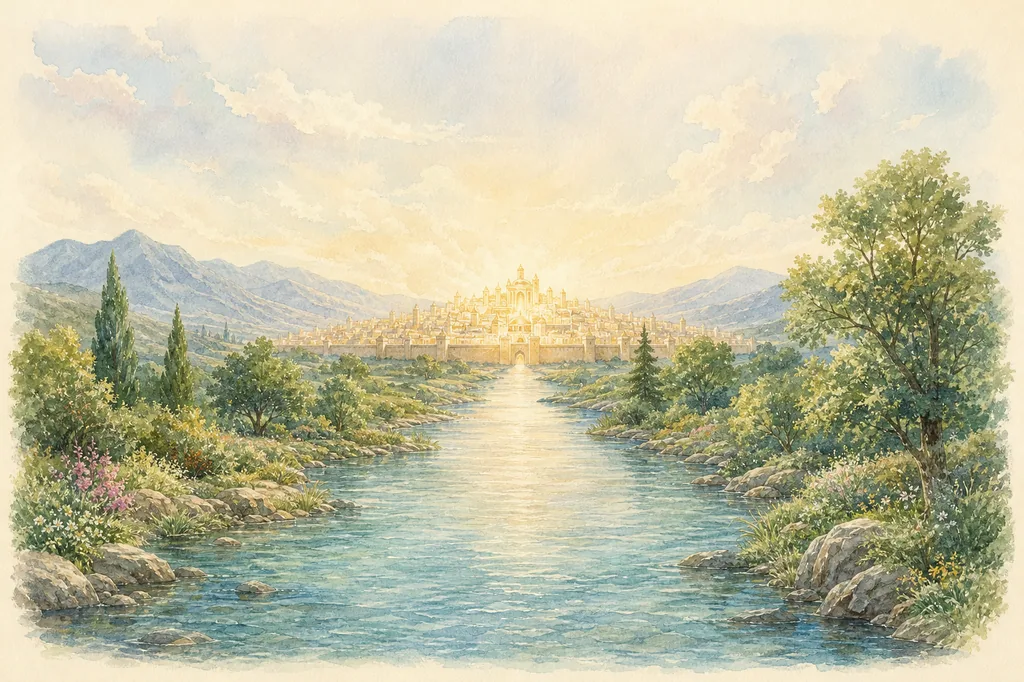
Revelation 21 opens with a new heaven and a new earth. Then John sees the holy city, New Jerusalem, coming down from God out of heaven. Pay attention to the direction. The story reaches its destination with God dwelling among people in a renewed creation.
The announcement is followed by a remarkably tender action: God wipes away their tears. Death, mourning, crying and pain are gone. For someone who has watched a loved one suffer, the promise has a face. The future John sees reaches the very things that make life feel unbearable now.
The city shines with precious stones and gold. Its gates stand open, and God's glory gives it light. John says there is no temple in it because God and the Lamb are its temple. The whole city enjoys the presence toward which a temple points.
Revelation 22 adds a river of life and the tree of life, with fruit and leaves for the healing of the nations. A Bible that began with a garden ends with life flourishing in a city. John's vision gives the nations healing and the hungry abundance. The curse is gone.
Christian hope therefore reaches beyond an escape from a damaged world. The Bible ends with God making things new. Bodies, people and creation have a future in that promise.
Resurrection gives the body a future
Paul spends much of 1 Corinthians 15 answering a question that can disappear behind popular pictures of heaven: what happens to the dead? His answer is resurrection. The body that dies in weakness is raised in power; what was perishable becomes imperishable.
Paul calls it a spiritual body. He is describing a transformed kind of bodily life, with Christ's resurrection as its foundation. The chapter keeps returning to what God will raise and change. The body's story does not end with its decay.
This also explains why being with Christ after death and the final resurrection are related promises rather than interchangeable phrases. Philippians 1 speaks of Paul's desire to be with Christ. First Corinthians 15 looks ahead to the dead being raised and death losing its victory. The final Christian hope includes that fuller renewal.
When you are grieving, such hope can be something to hold while you still cry. Revelation promises that God will wipe tears away; it does not scold people for having them now. You do not have to make a loss feel small to believe God will overcome death.
Paul ends his resurrection chapter by telling people to keep doing the Lord's work, because their labor is not in vain. A promised future gives present love a reason to persist: the meal you bring, the person you sit beside, the work you do faithfully.
Thomas asks how to get there
Back in John 14, Thomas interrupts with the question a reader may be asking too. If the disciples do not know where Jesus is going, how can they know the way? Jesus answers by pointing to himself as the way, the truth and the life, and says that people come to the Father through him.
The Christian answer to 'How do I get to heaven?' starts with Jesus. Ephesians 2:8-10 describes salvation as God's gift, received through faith, and rules out boasting in what we have earned. Good works follow as the life God calls his people to live.
That is a different starting point from keeping a private scorecard and hoping the good column wins. The invitation is to trust Christ, turn toward him, and receive the mercy you cannot manufacture for yourself. The life that grows from that trust has room for repentance, forgiveness and care for other people.
Paul's longing for Christ did not make the people around him disposable. In Philippians 1, he also says that remaining alive is needed for their sake. Heaven gives him hope beyond death and a reason to keep serving while he lives.
Read John 14 alongside Revelation 21 and the two promises belong together: Jesus receives his people, and God dwells with them. The deepest gift of the promised home is the one who welcomes them there.
Frequently asked questions
Do Christians go to heaven immediately after death?
Many Christians understand Paul's desire to depart and be with Christ in Philippians 1:23 as a promise of conscious life with him after death. Some traditions understand the dead as sleeping until resurrection. Both questions need to be read alongside the future resurrection described in 1 Corinthians 15.
Will we recognize people in heaven?
Many Christians expect recognition and renewed fellowship, drawing on the Bible's picture of personal resurrection and life together with God. Scripture does not explain every detail of how relationships will work. Its clearest promise is that God's people will be with him, with death and sorrow overcome.
Do people become angels when they die?
The Bible promises people resurrection, not a change into angels. In Matthew 22:30, Jesus compares the risen to angels regarding marriage; he does not say that humans become angels. First Corinthians 15 describes people receiving transformed bodies.
What will people do in heaven?
Revelation 22:3-5 pictures God's servants serving him, seeing his face and reigning with him. Its river, tree and city portray life in God's presence. God's people have a life to share and work to do, though the passage does not supply a daily schedule.